AI in RevOps: A Framework for 2026
Revenue teams are facing a wave of pressure to “do something with AI,” but the real challenge isn’t adoption; it’s knowing where AI will actually drive impact. While the technology is advancing quickly, not every investment leads to better outcomes. The risk isn’t falling behind; it’s adding complexity without improving performance.
As AI dominates headlines, many leaders are asking the same question: how do you move from experimentation to execution? The reality is that AI’s value isn’t in flashy demos or isolated use cases. It comes from applying it to real revenue bottlenecks, areas like pipeline visibility, forecasting accuracy, and rep productivity, where even small improvements can drive meaningful results.
This is where a practical, layered approach becomes critical.
What changes when AI is embedded directly into your go-to-market workflows instead of sitting on the sidelines?
Where does it create measurable lift across the lead-to-cash lifecycle?
How can teams prioritize AI use cases that deliver immediate value while building toward long-term transformation?
How should RevOps teams think about applying AI to lead routing, data enrichment, and forecasting?
And how do you balance new AI agents and capabilities with the systems and processes already in place?
At Hyperscayle, we’ve worked closely with B2B organizations navigating these exact challenges. In our ebook, AI in RevOps: A Framework, we share what we’ve seen consistently: the teams driving real results aren’t chasing every new tool; they’re focusing on high-impact use cases and implementing them in a way that aligns with their data, systems, and business goals.
In practice, that means starting with foundational AI applications like conversational intelligence, predictive scoring, automated CRM capture, and personalized outreach, use cases that enhance how teams already operate rather than replacing it entirely. It also means recognizing where newer capabilities, like natural language coding, can unlock custom solutions or reduce reliance on point tools when applied thoughtfully.
At the same time, the fundamentals still matter. Strong data foundations, well-defined processes, and clean system architecture are what enable AI to deliver accurate insights and scalable value. Without them, even the most advanced tools fall short.
The takeaway is simple: AI in RevOps works best when it is directly tied to revenue outcomes. When implemented with focus and discipline, it can improve win rates, increase forecast accuracy, reduce manual work, and help teams prioritize the opportunities that matter most.
The opportunity isn’t just to adopt AI, it’s to apply it where it counts.
TOP USE CASES FOR REVOPS
AI EXPERIENCE LAYER:
What are the best use cases for AI in RevOps? Here is the top 10:
CONVERSATIONAL INTELLIGENCE AND CALL ANALYSIS: Transcribes sales calls, highlights key moments like objections or competitor mentions, and surfaces coaching insights. Top reps catch buying signals and blockers instinctively; others don't. Conversational intelligence helps teams spot what matters.
AUTOMATED EMAIL PERSONALIZATION AND OUTREACH: Generates personalized emails at scale by analyzing prospect data, company news, and past successful messages. Personalization drives results. Al handles research and drafting so reps can focus on conversations.
AI SALES FORECASTING AND PIPELINE MANAGEMENT: Combines deal data, activity signals, and historical patterns to generate more accurate forecasts. Forecasts often reflect rep optimism. Al removes bias and shows what the data actually indicates.
PREDICTIVE LEAD SCORING AND PRIORITIZATION: Analyzes win/loss data to predict which opportunities are most likely to close and prioritizes your pipeline accordingly. Teams often spend time on deals that won't close. Al helps focus on the most qualified opportunities instead of the loudest ones.
INTELLIGENT MEETING SCHEDULING AND COORDINATION: Eliminates back-and-forth scheduling by analyzing calendars, time zones, and priorities to suggest optimal times. Reps spend 3 to 4 hours weekly on scheduling-150 plus hours yearly. Al saves time and smooths the buying process.
AUTOMATED CRM DATA ENTRY AND ACTIVITY CAPTURE: Analyzes deal stage, activity signals, conversations, and past patterns to generate accurate forecasts. Forecasts often reflect hope, not reality. Al removes optimism bias and shows what the data actually says.
AI-POWERED PROSPECTING AND LEAD GENERATION: Finds companies and contacts that match your ICP, enriches their data, and highlights warm introductions or engagement triggers. SDRs waste time on unqualified accounts. Al finds the needles in the haystack, so your team works only with qualified prospects.
SALES COACHING AND PERFORMANCE ОPTІMIZATION: Analyzes rep activity to highlight coaching opportunities and recommend skill development priorities. Managers can't review every call or email. Al spots top-performer patterns and shows where reps diverge.
CHURN REDUCTION AND WHITESPACE OPPORTUNITIES: Monitors customer health, flags at-risk accounts, and uncovers cross-sell and upsell opportunities from usage trends. Top customers can churn quietly. Al spots early warning signs and highlights expansion opportunities reps might miss.
COMPETITIVE INTELLIGENCE AND MARKET INSIGHTS: Monitors competitors, market trends, and customer sentiment to deliver timely insights. When competitors launch features, customers complain, or prospects mention alternatives, reps need real-time awareness.
NATURAL LANGUAGE CODING:
What are the main use cases for AI App Builders using Natural Language Coding in RevOps? Here are two of the best:
REPLACING POINT SOLUTIONS AND REDUCING SOFTWARE COSTS: A common example is replacing a lead routing tool with a custom solution. Since routing varies by business and isn't very complex, building your own can be simpler, more costeffective, and better aligned to your needs. Over time, replacing multiple point solutions can also lead to meaningful cost savings.
CUSTOM FUNCTIONALITY OFF-THE-SHELF, BUSINESS-BESPOKE: The second category is more varied and, by definition, unique to each business. A few examples include a custom sales commission tool that replaces an Excel-based process, a basic Configure Price Quote (CPQ) tool for creating quotes, or a custom dashboard that combines product usage and CRM data.
Our advice is to begin using these tools where they make sense, but be realistic about the work required to actually deploy and maintain. Introduce them in partnership with your IT team to ensure what RevOps builds fits your company's governance process.
INDIVIDUAL ACCELERATORS:
Slide and Copy Generation
Data Analysis
Research
Troubleshooting Systems Questions
Personal Computer Automation
RevOps teams should encourage their team to build familiarity with these tools and learn from their peers, with the caveat that clear governance is in place regarding safeguarding company or customer data.
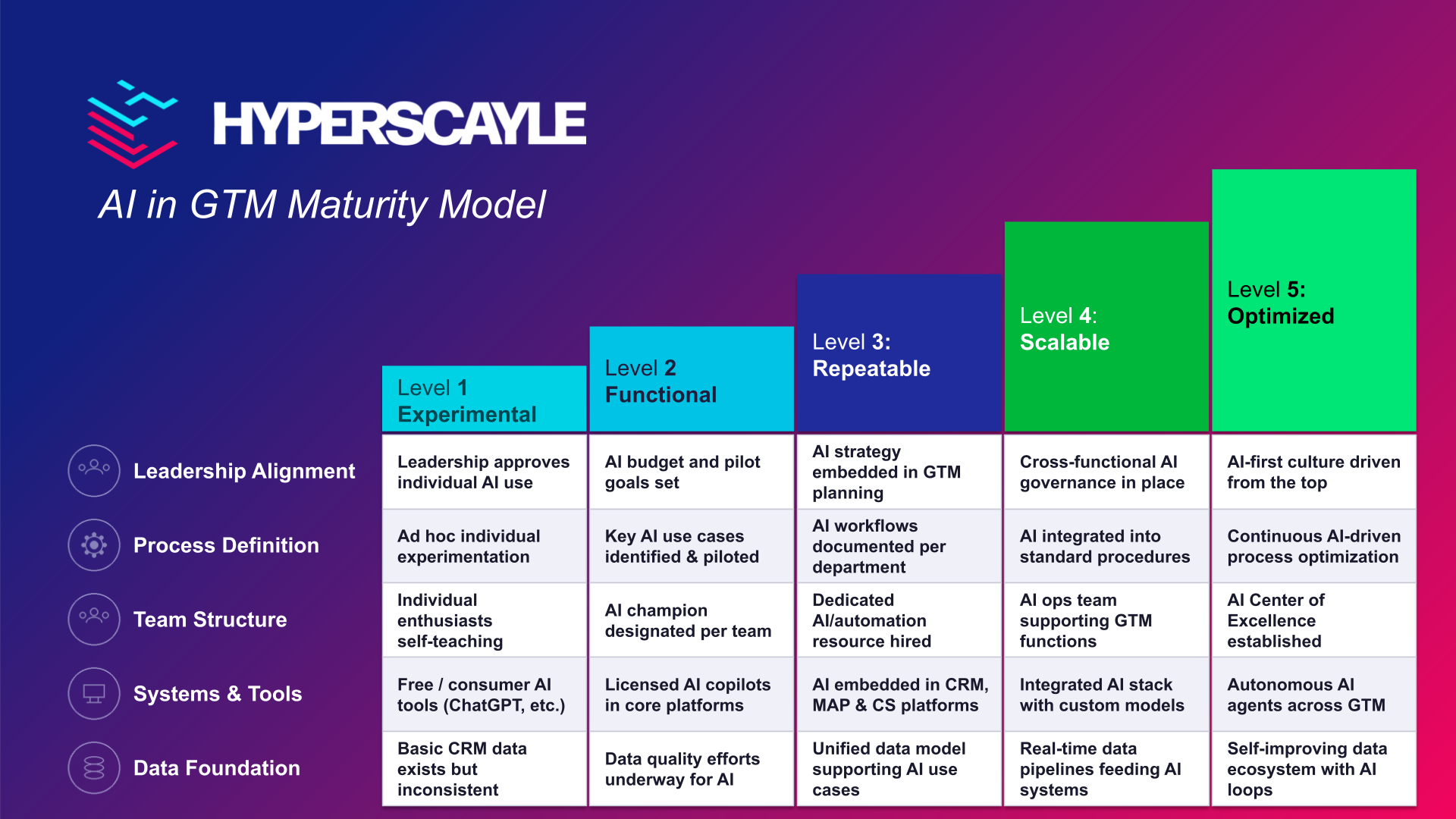
AI in RevOps Maturity Model
If you’re interested in learning more about our AI Transformation Program, click here.
About Hyperscayle:
Hyperscayle is a revenue operations consulting and implementation firm. We partner with our clients to help them grow and scale, delivering best in class RevOps process and systems that drive revenue from lead to cash. We provide both strategy and execution for your RevOps projects, designing business process and technical solutions, then putting hands on keyboards to implement them in your marketing, sales and finance systems. We’ve solved RevOps challenges across multiple industries, with a focus on SaaS, Manufacturing, Finance and Healthcare. If you’re interested in learning more about our unique approach to revenue operations consulting, click here to book a call.