RevOps Tech: Build Vs. Buy in Q2 of 2026

The RevOps Tech Build Vs. Buy Debate Has Changed
Every ops leader has had this conversation twenty times in the last year. Build vs. buy. With AI making it possible for non-engineers to ship working software, the question of when to build internally has moved from “rare and risky” to “Sometimes” in a lot of organizations.
Most of the takes I see on this question are reasonable. They land in roughly the same place: build the contained, low-impact stuff; buy the heavy, complex stuff; watch out for the hidden costs. The advice is usually right, sometimes overly cautious about the build side, and almost always missing the more important point.
The more important point is this: the line between “build” and “buy” is not static. It’s changing every time Anthropic or OpenAI releases a new model. The list of things in your “buy” column today is shorter than it was a few months ago, and it’ll be shorter again in another quarter. Wherever you draw the line right now, draw it in pencil.
That’s the framing this piece runs on. Same conversation everyone else is having, with the trajectory taken seriously.
What’s Actually Changed About Building RevOps Tools
Three things make this moment different from any previous build-vs-buy moment.
The tools work.Atlas (Hyperscayle is a partner; we use it ourselves and with clients) lets a non-technical operator describe an enterprise-grade workflow in plain English and get back a working application with complex functionality, role-based access, and audit logs. Claude Code does the same for anyone comfortable in a terminal. These tools ship real software that real teams use to run real revenue.
Natural language coding (NLC) is no longer only good for low-lift use cases. The default framing puts it in a “great for dashboards and small agents” bucket and stops there. That was true a few months ago, but over the last quarter we’ve shipped CPQ applications, deal desk approval routing, and custom partner portals with NLC platforms in weeks. None of those are toy use cases.
The current velocity is what most people focus on, but the real story is the acceleration. The capabilities of these tools at the end of this year will look noticeably different from where they sit today.
The Hidden Costs You’ve Heard About Have Aged
The standard cautionary list shows up in every build-vs-buy article: integration issues, compounding maintenance, the maturity gap, single-person risk, scope creep, compliance exposure. They were all real. Most of them used to be deal-breakers. Today, most of them have credible answers.
Integration issues. This used to be a major barrier to custom application development. Custom code talking to four SaaS tools, no shared observability, you’re the support team. Today, NLC platforms come with native connectors to the things GTM teams actually use, and Claude can write integration tests as easily as it writes the integration. When something breaks, you have a model that understands the whole stack and can debug it with you in real time. It is still possible to make a mess, but it is much harder to make a mess by accident.
Compounding maintenance. The fear is that every team change, every new field, every API update means rework. True. But the maintenance burden of NLC code looks nothing like the maintenance burden of code written in 2018. The model that wrote the original can rewrite the affected parts in minutes. Maintenance becomes a question of model cycles. Headcount stays flat.
The maturity gap. This is the one I push back on hardest. The argument is that mature platforms have accounted for years of edge cases you haven’t encountered. The implication here is that you can’t catch up. That’s no longer true. When an edge case shows up in your homegrown tool, you ask the model to handle it. It does. The “years of accumulated wisdom” packaged inside a SaaS product is increasingly something a competent operator with NLC can replicate very quickly.
Single-person risk. The classic concern: one person built it, only that person understands it, they leave, you’re stuck. The answer is that the model is the second person. Your codebase is documented, readable English the moment you ask the model to walk through it. We onboard new people to NLC-built apps in hours. The bus factor on a Claude Code project today is genuinely better than the bus factor on a typical Salesforce implementation.
Scope creep. This remains real, but it’s not specific to NLC. Any internal build creeps. So does any SaaS implementation. The fix is product discipline, not a vendor logo. If you can’t say no to “let’s add this new thing,” you can’t say no inside a vendor either; you’ll just spend the money on a higher subscription tier and an extra implementation cycle.
Compliance exposure. The risk is that you’re now responsible for SOC 2, GDPR, HIPAA, whatever applies. Pick your environment. This is the most legitimate concern out of this list, but it’s a solvable problem. Work closely with your security team, get them to bless everything you are doing. Also, look at the new generation of NLC tools like Atlas. If you build on Atlas, you inherit their compliance posture; you’re not standing up auth, encryption, and audit logging from scratch. If you build on raw Claude Code into your own AWS account, yes, you own more of the stack. Match the platform to the compliance bar you need and most of this risk gets absorbed by your runtime.
To be clear: I’m not arguing “always build.” The historical reasons to default to “buy” just have weaker grip than they used to. Go in with a bias toward action. Don’t go in scared.
A 2x2 For Where To Start With Build Vs Buy in RevOps Tech
Two axes: impact on revenue, effort to build and maintain. Four buckets.
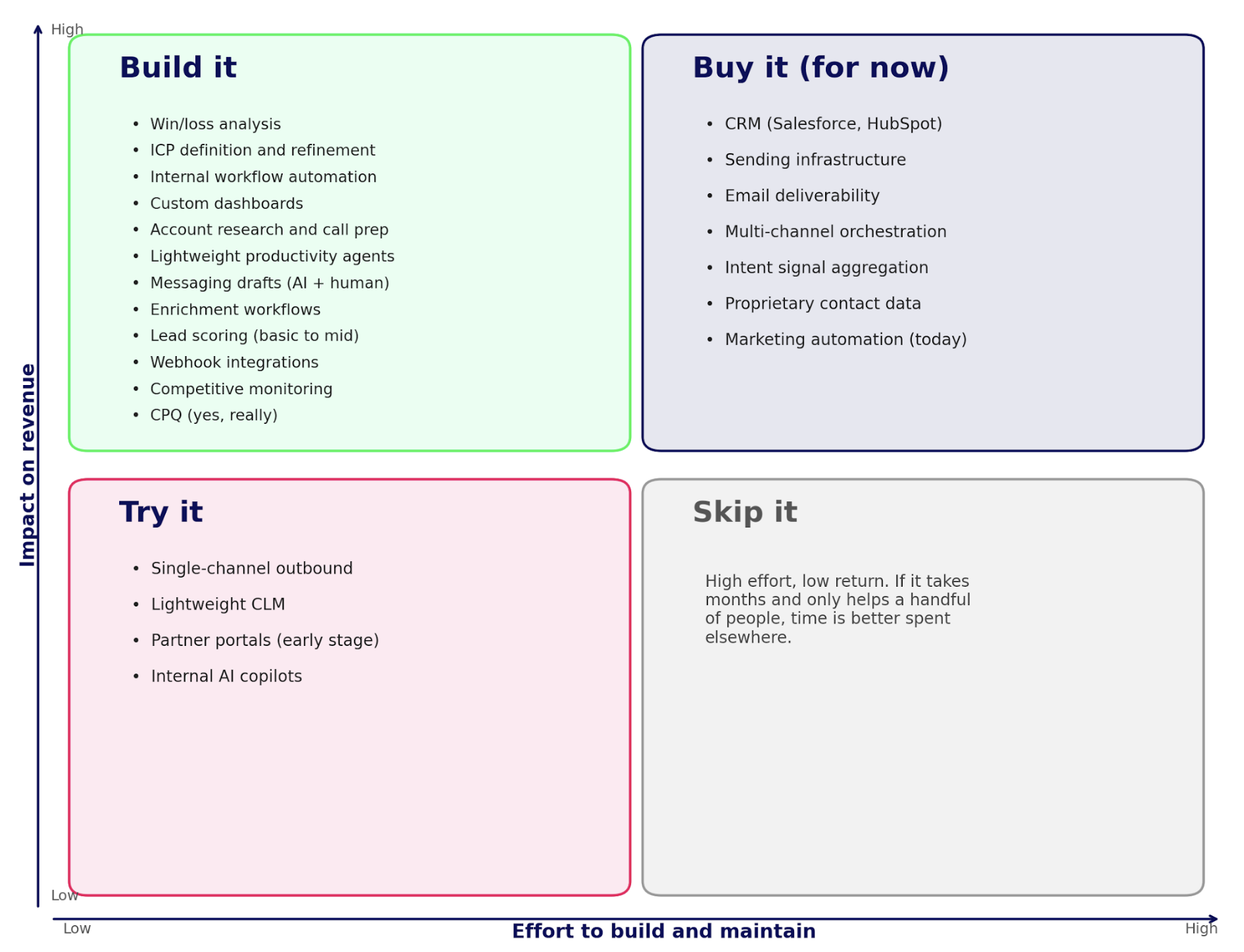
Build It (High Impact, Low Effort)
Win/loss analysis. ICP definition and refinement. Internal workflow automation. Custom dashboards. Account research and call prep. Lightweight productivity agents. Messaging drafts. Most enrichment workflows. Basic and intermediate lead scoring. Webhook integrations. Competitive monitoring. CPQ.
CPQ is usually the most surprising one on that list. People put it in the buy column out of habit. I disagree. CPQ is overwhelmingly about encoding your specific pricing rules, your specific approval flows, and your specific quote outputs. The platforms in this space (Salesforce CPQ, formerly SteelBrick, and the rest) are configuration shells around your business logic. You’re paying $300+ per user per month to encode your own rules in their tool. With NLC, you can encode the same rules in a custom app in a fraction of the time, with a UI sellers actually like, and without paying a high per seat cost.
It’s the use case I’d point to first if you’re skeptical. Hyperscayle does a lot of CPQ work, and it’s where I see the cost-of-buying gap most clearly.
Try It (Lower Impact or Moderate Effort)
Single-channel outbound stays here for one reason: deliverability is real domain expertise and you don’t want to learn it on your own warm pool. Lightweight contract lifecycle work fits here too, along with early-stage partner portals and internal AI copilots that span more than one team.
Buy It (For Now)
Core CRM. Sending infrastructure and email deliverability. Multi-channel orchestration where it depends on a vendor’s network effects. Intent signal aggregation (you don’t have the data sources). Proprietary contact data. Marketing automation. Anything where the vendor’s value is data they have and you don’t.
Skip It (High eEffort, Low Return)
If it takes months to build and only serves a handful of people, your time is better spent somewhere else.
The reason “(for now)” is glued to the buy bucket is the next section.
The Buy Column Is A Moving Target
This is the most important point in the whole conversation, and it deserves its own section.
These NLC models are improving on an exponential curve. Whatever’s in the buy column today, that list is going to shrink every few months.
Take the most extreme example. Today, building your own CRM to replace Salesforce is not a credible move for any company with a real go-to-market motion. Salesforce has 25 years of object model, permissions, declarative configuration, partner ecosystem, and reporting that you’d have to recreate. The pragmatic answer is: don’t.
It would be foolish to assume that’s permanent. The reason that build is not credible today is that the surface area of features you’d need to recreate is bigger than what any one team can ship with current tools. That surface area is mostly stable. The capability of NLC tools to ship that surface area is growing very fast. Those two lines are going to cross. Maybe in three years. Maybe in one. No one can see the future, but the pace of change leads to the reasonable conclusion that it’s a matter of when, not if.
This is the part most build-vs-buy conversations skip. They categorize each use case as if today’s categorization is the answer. It is not. Today’s categorization is a snapshot.
8 Questions To Ask Before You Build The RevOps Tech Stack
Use these before you commit to any app builder for revops:
What’s the impact on revenue? Direct revenue impact, shorter cycle time, recovered loss, or a nice-to-have at the edges?
Who is this for? One person, one team, or the whole org? Builds are now cheap enough that even one-team payoff can justify them, but bigger audiences still get bigger leverage.
What does the build actually cost in calendar time? Days, not weeks. Weeks, not months. If your honest estimate is months with NLC, ask why. The model is probably telling you the scope is too big.
What’s the maintenance load? How often will it need rework, and who handles it? NLC code that lives next to the model that wrote it has a different maintenance profile than custom code in a vacuum.
What’s the blast radius if it breaks? A broken internal dashboard is annoying. A broken billing feed is a fire. Match the rigor to the risk.
What does buying actually cost? Fully loaded. Per-seat fees, implementation services, professional services to customize, ongoing admin. Compare to a current NLC build estimate, not a hypothetical one from 2025.
What’s the opportunity cost? Whoever builds this isn’t doing the thing they’d otherwise do. Is that a worthwhile trade?
How custom does this need to be? The more your competitive value depends on doing this differently from everyone else, the more building wins. The more it’s table stakes that just needs to work, the more buying wins.
So, To Vibe Or Not To Vibe?
Yes, but do it with intent.
Whatever 2x2 you draw today is going to look different the next time you draw it. The right answer for any specific tool is a function of where the model curve has gotten to. The right answer for the build-vs-buy question generally is to recheck your assumptions every six months and update your defaults.
It is also crucial to pursue natural language coding projects in the context of a wider AI strategy. Make a plan that includes AI experience layer platforms and individual accelerators along with Natural Language Coding. Get your data in good shape before starting any of it.
My honest read: NLC is meaningfully underrated for real, scaled enterprise software, not just one-off agents. The teams that figure that out first are going to ship faster, customize harder, and pay less than the teams that keep defaulting to buy out of habit.
If you’re standing at a build-vs-buy decision today, default to a serious estimate of the build before you sign the contract. The estimate looks different than it did last year. It’ll look different again in a few months.
About Hyperscayle:
Hyperscayle is a revenue operations consulting and implementation firm. We partner with our clients to help them grow and scale, delivering best in class RevOps process and systems that drive revenue from lead to cash. We help companies build and improve their go-to-market operations, combining deep RevOps strategy, systems work, and AI delivery to pair the capabilities of a large consultancy with the responsiveness of a specialized team.
We provide both strategy and execution for your RevOps projects, designing business process and technical solutions, then putting hands on keyboards to implement them in your marketing, sales and finance systems. We’ve solved RevOps challenges across multiple industries, with a focus on SaaS, Manufacturing, Finance and Healthcare.
If you're thinking through where agents fit in your RevOps roadmap and what to build centrally versus what to leave to individual teams, book a call with our team.