
AI Agents in RevOps are having their moment. Most of the conversation is either too abstract to act on or zeroed in on one founder's weekend demo. If you run RevOps, what you actually need is a way to decide where agents belong in the team you already run.
I think about agents in revenue operations as falling into two buckets. Each has a different owner and a different payoff. Getting the split right is what separates orgs that quietly compound productivity from orgs that buy a dozen tools and can't tell you what changed six months later.
The Two Buckets for AI in RevOps
Personal agents are configured for an individual contributor. A salesperson, a marketer, a CSM. They make that specific person faster and sharper in their day-to-day work.
Universal agents run in the background as part of the RevOps technology stack. They do work on behalf of the whole GTM org without being tied to any one user.
Both matter. Both are worth investing in. They're built and governed very differently, though, and treating them as the same thing is one of the most common reasons AI programs stall.
Personal AI Agents
A caveat up front. I think one-off personal agents, the kind a single salesperson spins up over a weekend to prospect for them, are overrated. The demos are real. They just don't scale across a 50-person sales org. What I'm describing here is different.
A personal agent gets interesting when the core is designed centrally and rolled out to the team. Shared core, customized edges. RevOps or enablement builds the foundation. Each rep tunes their own voice and their own briefing cadence on top of it.
The foundation is where the real work sits. The company's brand voice, with the words to use and the words to avoid. The sales process, and who approves what. Territory, discount authority, target account list. Where the files live. What the rep is allowed to do and what needs sign-off.
What This Looks Like For A Salesperson
Every rep starts the day with a Slack message from their agent. Today's calls. Fresh research the agent pulled overnight on each account. Talking points it thinks should lead the conversation. A reminder of what was said last time. Any news, funding events, or leadership changes worth knowing before the call.
Through the day, the same agent drafts follow-up emails in the rep's voice, updates Salesforce or HubSpot with call notes, preps briefs for upcoming meetings, and pulls the right collateral from the content library for the stage and industry of each deal.
All of this is buildable with tools available today. Claude, Atlas, native CRM APIs, Slack. More sales teams don't have it running because nobody's done the work of standing up a shared foundation and rolling it out thoughtfully. The tech is there.
What This Looks Like For A Marketer
Same model, different content. A marketer's agent inherits the brand guide, approved terminology, product positioning, and campaign playbooks. It writes copy in the company's voice by default. If the marketer publishes under their own byline, it adapts to their voice as well.
Beyond writing, the agent knows where the templates live, which assets are approved for which audiences, how the content review process works, and what's on the current content calendar. That knowledge compounds. Every new hire gets the institutional memory on day one instead of six months in.
Why The Shared-Core Model Matters
The temptation is to let each person build their own. I'd push back on that. You'll end up with inconsistent brand voice and no way to improve the fleet as a whole.
RevOps or marketing ops owns the shared core. Individuals customize the edges. When the sales process changes, a new competitor emerges, or a new product launches, you update the core once. The whole team benefits the next morning.
Universal AI Agents
The second bucket looks nothing like the first from a user's point of view. A universal agent has no one human it serves. It runs in the background, maintained by RevOps, doing the kind of ongoing operational work that used to get crammed into batch jobs, quarter-end cleanup projects, or a Monday to-do list that never got done.
These agents aren't visible to a rep or a marketer day-to-day. They're always on. They're the connective tissue that keeps the GTM engine clean and current.
What They Do
The most useful universal agents sit on top of your systems of record and handle work that's too tedious for a person to do consistently and too nuanced for rigid automation to handle well.
A few patterns I've seen land well:
Keeping strategic accounts current. An agent continuously refreshes firmographic and contact data on the accounts that matter most, pulls in recent news and signals, and writes it back to the CRM so the team is always looking at a live picture.
Tracking job changes. When a champion, economic buyer, or key contact changes jobs, the agent notices, updates the record, and notifies the account owner. Churn risk at the old company. Expansion opportunity at the new one.
CRM data enrichment. Instead of stacking three enrichment vendors, an agent can work with the sources you already have, spot the gaps, and fill them continuously.
Intelligent lead routing. The agent weighs territory, account history, rep capacity, product fit, and prior engagement before assigning, so routing becomes context-aware instead of a static rules engine.
Notifications with real context. When something meaningful happens, say a deal slips, an account goes dark, or a high-value prospect hits the pricing page twice in 48 hours, the agent decides who needs to know and delivers the message with enough context to act on.
Why Universal AI Agents Belong to RevOps
A universal agent lives in the stack. It has to be governed like any piece of infrastructure. Clear ownership. Clear data access. Clear rules for what it can write back to Salesforce or HubSpot. Clear process for monitoring what it does.
RevOps is the right owner. The team that already governs your CRM, marketing automation, and lead lifecycle is the team that should govern the agents operating on top of them. Letting individual users configure these ad hoc, or buying them as bolt-ons inside a dozen point tools, is how you end up with conflicting data and nobody accountable when something breaks.
One related point worth flagging. I'd be careful about leaning hard on whatever agent platform your CRM vendor is selling. Agentforce and Breeze today are weaker than what you can build using Claude or Atlas on top of your existing data, and the gap isn't closing fast enough to wait for them to catch up.
How The Two Work Together
Personal and universal AI agents are complementary layers of the same engine. Universal agents keep the underlying data and processes clean and current. Personal agents sit on top and make contributors faster.
A personal agent is far more useful when the CRM data it's reasoning over has been enriched and de-duplicated by a universal agent running quietly in the background. A universal agent is more impactful when the people it serves have personal agents capable of acting on what it surfaces.
The orgs getting real value out of agents invest in both layers deliberately. Picking one and hoping the other shows up on its own doesn't work.
Where To Start With AI Agents For RevOps
A practical sequence:
Start with universal AI agents that protect data quality. An agent that keeps your top accounts enriched and de-duplicated creates compounding value for everything else you build. If the data foundation is weak, nothing on top of it works.
In parallel, pilot a personal AI agent with one team. A sales pod. Product marketing. Pick something contained. Build the shared core once: company voice, process, guardrails, access to the right files and systems. Let each person customize the edges. Measure what actually changes in their day before you scale.
Expand the personal agent rollout as the patterns stabilize. Codify the shared core so every new hire gets a working agent on day one. Treat the fleet as a product that improves over time, not a one-time deployment.
Keep adding universal AI agents as you identify the next tedious, always-on task your team's doing by hand. Lead routing, job-change monitoring, deal-slip detection, account refresh. Each one removes a layer of drag.
And govern deliberately. Personal agents need clear policies on what data they can access and what actions they can take on behalf of the user. Universal agents need the rigor you'd apply to any production system. The orgs moving fastest with agents have the clearest controls.
If you’re interested in learning more, please visit the AI Transformation Program page and watch the webinar AI in RevOps: Real-World Use Cases for the AI Experience Layer.
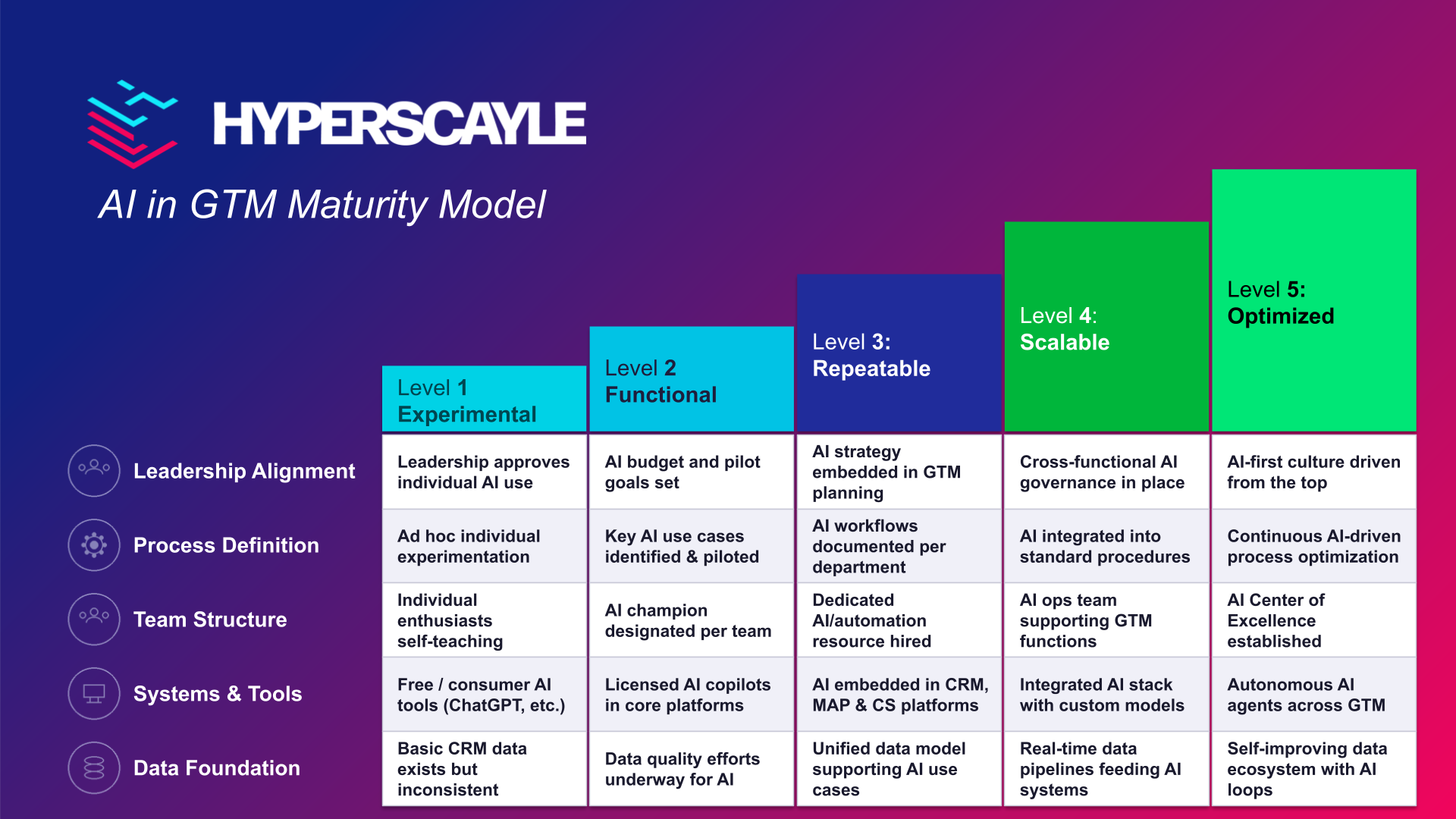
The AI in RevOps Maturity Model
About Hyperscayle:
Hyperscayle is a revenue operations consulting and implementation firm. We partner with our clients to help them grow and scale, delivering best in class RevOps process and systems that drive revenue from lead to cash. We help companies build and improve their go-to-market operations, combining deep RevOps strategy, systems work, and AI delivery to pair the capabilities of a large consultancy with the responsiveness of a specialized team.
We provide both strategy and execution for your RevOps projects, designing business process and technical solutions, then putting hands on keyboards to implement them in your marketing, sales and finance systems. We’ve solved RevOps challenges across multiple industries, with a focus on SaaS, Manufacturing, Finance and Healthcare.
If you're thinking through where agents fit in your RevOps roadmap and what to build centrally versus what to leave to individual teams, book a call with our team.